In this notebook we introduce the pathfinder Zhang et al., 2022 algorithm and we show how to use it as a variational inference method or as an initialization tool for MCMC kernels.
Notebook Cell
import matplotlib.pyplot as plt

plt.rcParams["axes.spines.right"] = False
plt.rcParams["axes.spines.top"] = False
import jax
from datetime import date
rng_key = jax.random.key(int(date.today().strftime("%Y%m%d")))from matplotlib.patches import Ellipse
from sklearn.datasets import make_biclusters
import numpy as np
import jax.numpy as jnp
import blackjaxThe Data
We create two clusters of points using scikit-learn’s make_bicluster function.
num_points = 50
X, rows, cols = make_biclusters(
    (num_points, 2), 2, noise=0.6, random_state=314, minval=-3, maxval=3
)
y = rows[0] * 1.0  # y[i] = whether point i belongs to cluster 1
Source
colors = ["tab:red" if el else "tab:blue" for el in rows[0]]
_, ax = plt.subplots(figsize=(6, 6))
ax.scatter(*X.T, edgecolors=colors, c="none")
ax.set(xlabel=r"$X_0$", ylabel=r"$X_1$");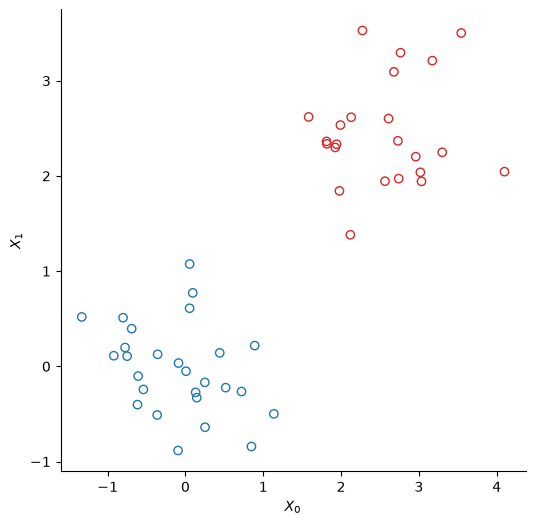
The Model
We use a simple logistic regression model to infer to which cluster each of the points belongs. We note a binary variable that indicates whether a point belongs to the first cluster:
The probability to belong to the first cluster commes from a logistic regression:
where is a vector of weights whose priors are a normal prior centered on 0:
And is the matrix that contains the data, so each row is the vector
Phi = X
N, M = Phi.shape


def sigmoid(z):
    return jnp.exp(z) / (1 + jnp.exp(z))


def log_sigmoid(z):
    return z - jnp.log(1 + jnp.exp(z))


def logdensity_fn(w, alpha=1.0):
    """The log-probability density function of the posterior distribution of the model."""
    log_an = log_sigmoid(Phi @ w)
    an = Phi @ w
    log_likelihood_term = y * log_an + (1 - y) * jnp.log(1 - sigmoid(an))
    prior_term = alpha * w @ w / 2

    return -prior_term + log_likelihood_term.sum()
Pathfinder: Parallel Quasi-Newton Variational Inference
Starting from a random initialization, Pathfinder locates normal approximations to the target density along a quasi-Newton optimization path, with local covariance estimated using the inverse Hessian estimates produced by the optimizer. Pathfinder returns draws from the approximation with the lowest estimated Kullback-Leibler (KL) divergence to the true posterior. The optimizer is the limited memory BFGS algorithm.
To help understand the approximations that pathfinder evaluates during its run, here we plot for each step of the L-BFGS optimizer the approximation of the posterior distribution of the model derived by pathfinder and its ELBO:
# L-BFGS can occasionally fail to converge from a bad initialization;
# retry until the ELBO path is finite.
stop = 0
while stop == 0:
    rng_key, init_key, infer_key = jax.random.split(rng_key, 3)
    w0 = jax.random.multivariate_normal(init_key, 2.0 + jnp.zeros(M), jnp.eye(M))
    _, info = blackjax.vi.pathfinder.approximate(infer_key, logdensity_fn, w0, ftol=1e-6)
    path = info.path
    stop = np.isfinite(path.elbo).mean()
Source
def ellipse_confidence(mu, cov, ax, c, n_std=2.0):
    import numpy as np

    lambda_, v = np.linalg.eigh(np.asarray(cov))
    lambda_ = np.sqrt(lambda_)
    ellipse = Ellipse(
        xy=(*mu,),
        width=lambda_[0] * n_std * 2,
        height=lambda_[1] * n_std * 2,
        angle=np.degrees(np.arctan2(*v[:, 0][::-1])),
        facecolor=c,
        edgecolor="b",
        alpha=0.1,
    )
    return ax.add_artist(ellipse)


step = 0.1
x_, y_ = jnp.mgrid[-1:3:step, -1:3:step]
pos_ = jnp.dstack((x_, y_))
logp_ = jnp.nan_to_num(
    jax.vmap(logdensity_fn)(pos_.reshape(-1, M)).reshape(pos_.shape[0], pos_.shape[1]),
    nan=-1e10,
)
levels_ = jnp.percentile(logp_.flatten(), jnp.linspace(60, 100, 10))


steps = (jnp.isfinite(path.elbo)).sum()
rows = int(jnp.ceil(steps / 3))
fig, axs = plt.subplots(rows, 3, figsize=(15, 5 * rows), sharex=True, sharey=True)

for i, ax in zip(range(steps), axs.flatten()):

    ax.contour(x_, y_, logp_, levels=levels_)
    state = jax.tree.map(lambda x: x[i], path)
    sample_state, _ = blackjax.vi.pathfinder.sample(rng_key, state, 10_000)
    position_path = path.position[: i + 1]
    ax.plot(
        position_path[:, 0],
        position_path[:, 1],
        marker="*",
        linestyle="--",
        markersize=10,
    )
    mu_i, cov_i = sample_state.mean(0), jnp.cov(sample_state, rowvar=False)
    ellipse_confidence(mu_i, cov_i, ax, "r")
    ax.set_title(f"Iteration: {i+1}\nEstimated ELBO: {state.elbo:.2f}")
plt.show()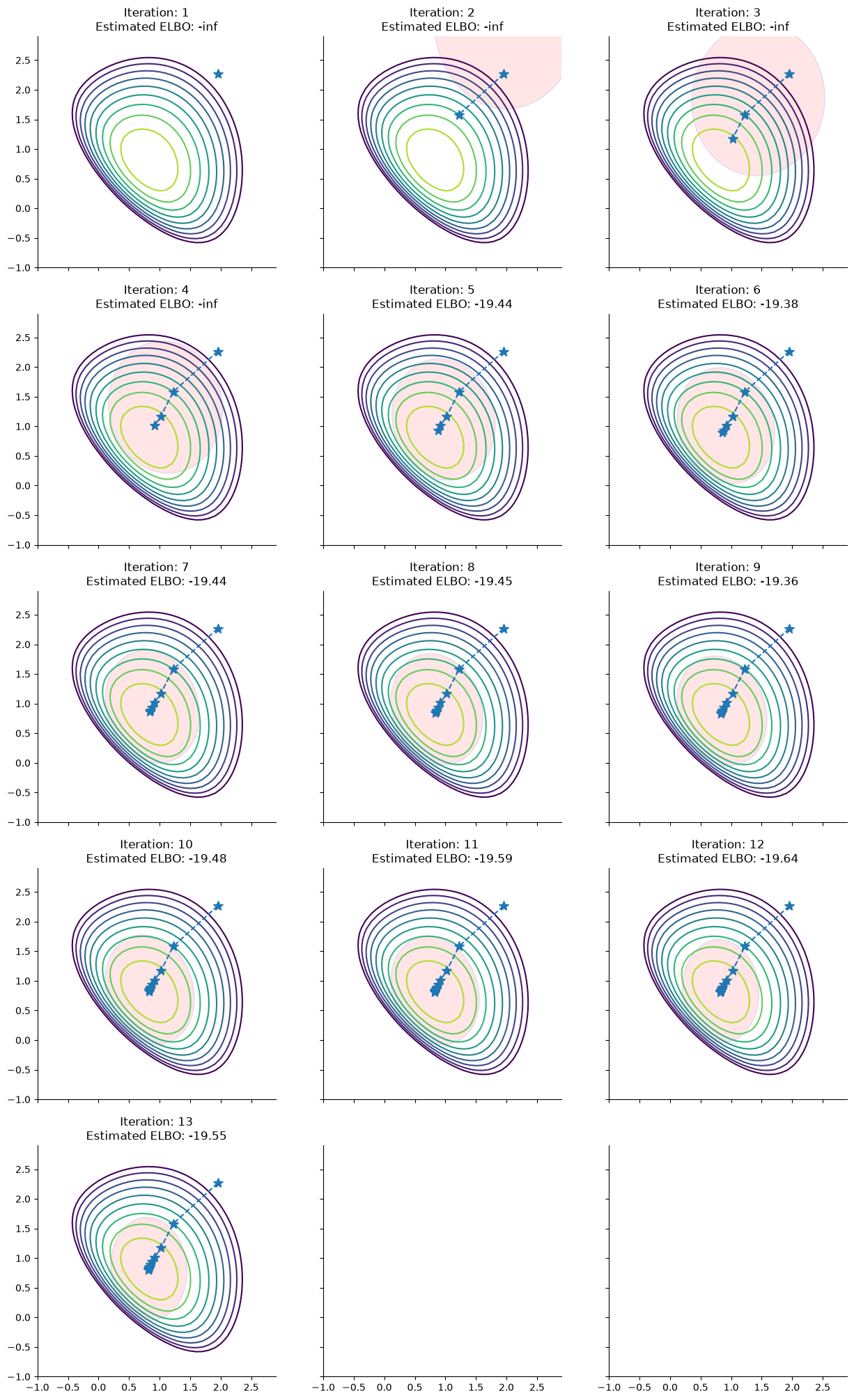
Pathfinder as a Variational Inference Method
Pathfinder can be used as a variational inference method. We first create a pathfinder object pf which contains two functions init and sample:
pf = blackjax.pathfinder(logdensity_fn)
rng_key, approx_key = jax.random.split(rng_key)
state, _ = pf.init(approx_key, w0, ftol=1e-4)
We can now get samples from the approximation:
rng_key, sample_key = jax.random.split(rng_key)
samples, _ = pf.sample(sample_key, state, 5_000)
And display the trace:
Source
fig, ax = plt.subplots(1, 2, figsize=(8, 2), sharey=True)
for i, axi in enumerate(ax):
    axi.plot(samples[:, i])
    axi.set_title(f"$w_{i}$")
plt.show()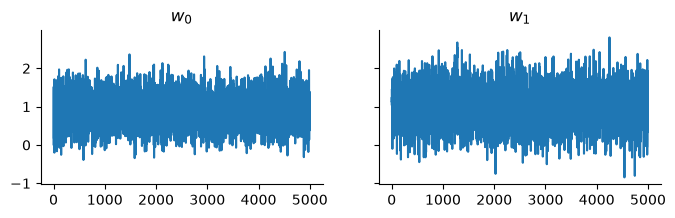
Please note that pathfinder is implemented as follows:
it runs L-BFGS optimization and finds the best approximation in the
initphasestepphase it’s just sampling from a multinormal distribution, whose parameters have been already estimated
Hence it makes sense to jit the init function and then use the sample helper function in the pathfinder object instead of implementing the inference loop:
%%time

state, _ = jax.jit(pf.init)(approx_key, w0)
samples, _ = pf.sample(sample_key, state, 5_000)
CPU times: user 5.69 s, sys: 151 ms, total: 5.84 s
Wall time: 2.89 s
Quick comparison against the Rosenbluth-Metropolis-Hastings kernel rmh:
def inference_loop(rng_key, kernel, initial_state, num_samples):
    @jax.jit
    def one_step(state, rng_key):
        state, info = kernel(rng_key, state)
        return state, (state, info)

    keys = jax.random.split(rng_key, num_samples)
    return jax.lax.scan(one_step, initial_state, keys)


rmh = blackjax.rmh(
    logdensity_fn, blackjax.mcmc.random_walk.normal(sigma=jnp.ones(M) * 0.7)
)
state_rmh = rmh.init(w0)
rng_key, sample_key = jax.random.split(rng_key)
_, (samples_rmh, _) = inference_loop(sample_key, rmh.step, state_rmh, 5_000)
Source
fig, ax = plt.subplots(2, 2, figsize=(10, 4), sharey=True)
for i in range(2):
    ax[i, 0].plot(samples_rmh.position[:, i])
    ax[i, 0].axvline(x=300, c="tab:red")
    ax[i, 0].set_ylabel(f"$w_{i}$")
    ax[i, 1].plot(samples[:, i])

ax[0, 0].set_title("RMH")
ax[0, 1].set_title("Pathfinder")
fig.show()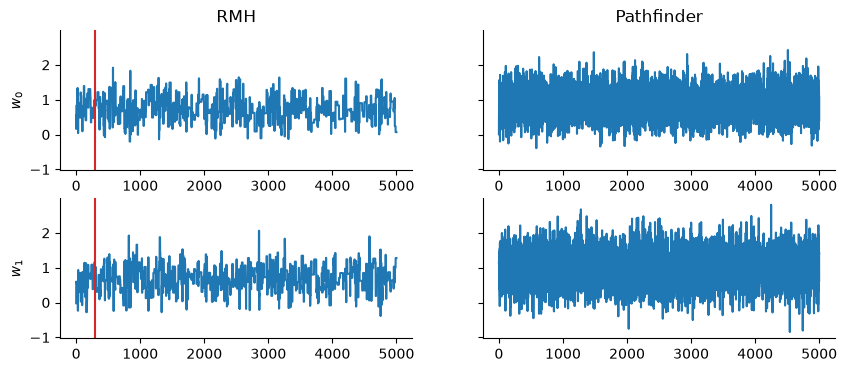
Pathfinder as an Initialization Tool for MCMC Kernels
Pathfinder uses internally the inverse hessian estimation of the L-BFGS optimizer to evaluate the approximations to the target distribution along the quasi-Newton optimization path.
We can calculate explicitly this inverse hessian matrix for a step of the optimization path using the blackjax.optimizers.lbfgs.lbfgs_inverse_hessian_formula_1 function:
from blackjax.optimizers.lbfgs import lbfgs_inverse_hessian_formula_1

inverse_mass_matrix = lbfgs_inverse_hessian_formula_1(
    state.alpha, state.beta, state.gamma
)
inverse_mass_matrix
Array([[ 0.16326791, -0.0186634 ],
[-0.01866339, 0.2359373 ]], dtype=float32)This estimation of the inverse mass matrix, coupled with Nesterov’s dual averaging adaptation for estimating the step size, yields an alternative adaptation scheme for initializing MCMC kernels.
This scheme is implemented in blackjax.pathfinder_adaptation function:
adapt = blackjax.pathfinder_adaptation(blackjax.nuts, logdensity_fn)
rng_key, sample_key = jax.random.split(rng_key)
(state, parameters), info = adapt.run(sample_key, w0, 400)
nuts = blackjax.nuts(logdensity_fn, **parameters)
init0 = nuts.init(state.position)
rng_key, sample_key = jax.random.split(rng_key)
_, (samples_nuts, _) = inference_loop(sample_key, nuts.step, init0, 5000)Source
_, axes = plt.subplots(1, 2, figsize=(10, 4), sharex=True)
hist_args = dict(bins=50, density=True, alpha=0.75, histtype="step", lw=2)
for i, ax in enumerate(axes):
    for samples_sel in [samples_rmh.position, samples_nuts.position, samples]:
        ax.hist(samples_sel[:, i], **hist_args)
ax.legend(["RMH", "NUTS", "Pathfinder"]);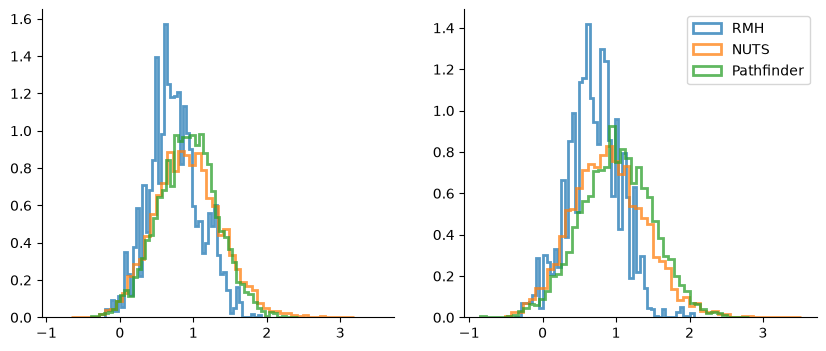
Some Caveats
L-BFGS algorithm struggles with float32s and log-likelihood functions; it’s suggested to use double precision numbers. In order to do that in
jaxa configuration variable needs to be set up at initialization time (see here)Otherwise you can stick with float32 mode and try to tweak
ftol,gtol, or the initialization pointIt may make sense to start pathfinder with a “bad” initialization point, in order to make the L-BFGS algorithm run longer and have more datapoints to estimate the inverse hessian matrix.
- Zhang, L., Carpenter, B., Gelman, A., & Vehtari, A. (2022). Pathfinder: Parallel quasi-Newton variational inference.