Multimodal distributions are typically hard to sample from, in particular using energy based methods such as HMC, as you need high energy levels to escape a potential well.
Tempered SMC helps with this by considering a sequence of distributions:
where the tempering parameter takes increasing values between 0 and 1. Tempered SMC will also particularly shine when the MCMC step is not well calibrated (too small step size, etc) like in the example below.
Imports
Notebook Cell
import matplotlib.pyplot as plt

plt.rcParams["axes.spines.right"] = False
plt.rcParams["axes.spines.top"] = False
import jax
from datetime import date
rng_key = jax.random.key(int(date.today().strftime("%Y%m%d")))import numpy as np
import jax.numpy as jnp
from jax.scipy.stats import multivariate_normal
import blackjax
import blackjax.smc.resampling as resampling
from blackjax.smc import extend_paramsSampling From a Bimodal Potential
Experimental Setup
We consider a prior distribution
and a potential function
This corresponds to the following distribution. We plot the resulting tempered density for 5 different values of : from which correponds to the original density to . The lower the value of the easier it is for the sampler to jump between the modes of the posterior density.
def V(x):
    return 5 * jnp.square(jnp.sum(x**2, axis=-1) - 1)


def prior_log_prob(x):
    d = x.shape[-1]
    return multivariate_normal.logpdf(x, jnp.zeros((d,)), jnp.eye(d))


linspace = jnp.linspace(-2, 2, 5000)[..., None]
lambdas = jnp.linspace(0.0, 1.0, 5)
prior_logvals = prior_log_prob(linspace)
potential_vals = V(linspace)
log_res = prior_logvals - lambdas[..., None] * potential_vals

density = jnp.exp(log_res)
normalizing_factor = jnp.sum(density, axis=1, keepdims=True) * (
    linspace[1] - linspace[0]
)
density /= normalizing_factor
Source
fig, ax = plt.subplots(figsize=(12, 8))
ax.plot(linspace.squeeze(), density.T)
ax.legend(list(lambdas))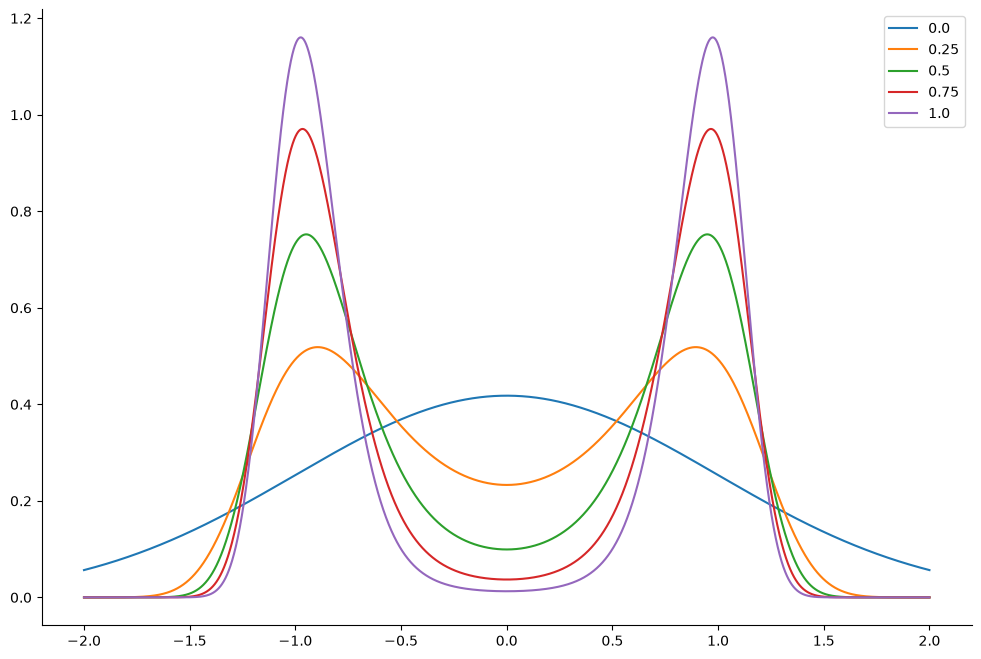
def inference_loop(rng_key, mcmc_kernel, initial_state, num_samples):
    @jax.jit
    def one_step(state, k):
        state, _ = mcmc_kernel(k, state)
        return state, state

    keys = jax.random.split(rng_key, num_samples)
    _, states = jax.lax.scan(one_step, initial_state, keys)

    return states


def full_logdensity(x):
    return -V(x) + prior_log_prob(x)


inv_mass_matrix = jnp.eye(1)
n_samples = 10_000
Sample with HMC
We first try to sample from the posterior density using an HMC kernel.
%%time

hmc_parameters = dict(
    step_size=1e-4, inverse_mass_matrix=inv_mass_matrix, num_integration_steps=50
)

hmc = blackjax.hmc(full_logdensity, **hmc_parameters)
hmc_state = hmc.init(jnp.ones((1,)))

rng_key, sample_key = jax.random.split(rng_key)
hmc_samples = inference_loop(sample_key, hmc.step, hmc_state, n_samples)
CPU times: user 3.11 s, sys: 110 ms, total: 3.22 s
Wall time: 2.44 s
Source
samples = np.array(hmc_samples.position[:, 0])
_ = plt.hist(samples, bins=100, density=True)
_ = plt.plot(linspace.squeeze(), density[-1])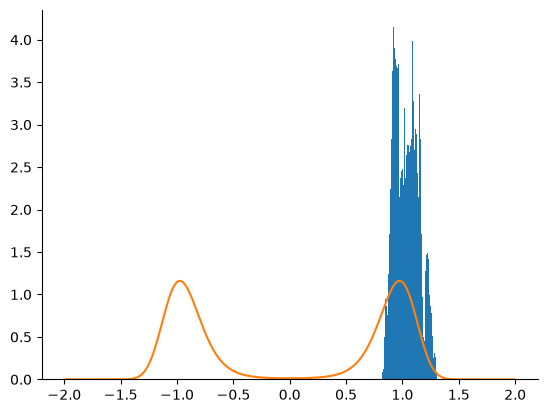
Sample with NUTS
We now use a NUTS kernel.
%%time

nuts_parameters = dict(step_size=1e-4, inverse_mass_matrix=inv_mass_matrix)

nuts = blackjax.nuts(full_logdensity, **nuts_parameters)
nuts_state = nuts.init(jnp.ones((1,)))

rng_key, sample_key = jax.random.split(rng_key)
nuts_samples = inference_loop(sample_key, nuts.step, nuts_state, n_samples)
CPU times: user 24.8 s, sys: 194 ms, total: 25 s
Wall time: 24.1 s
Source
samples = np.array(nuts_samples.position[:, 0])
_ = plt.hist(samples, bins=100, density=True)
_ = plt.plot(linspace.squeeze(), density[-1])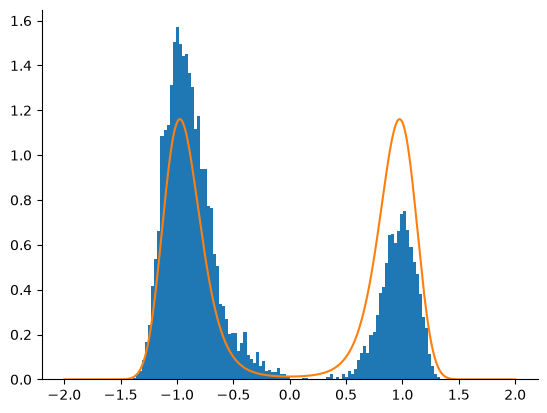
Tempered SMC with HMC Kernel
We now use the adaptive tempered SMC algorithm with an HMC kernel. We only take one HMC step before resampling. The algorithm is run until crosses the limit.
def smc_inference_loop(rng_key, smc_kernel, initial_state):
    """Run the temepered SMC algorithm.

    We run the adaptive algorithm until the tempering parameter lambda reaches the value
    lambda=1.

    """

    def cond(carry):
        i, state, _k = carry
        return state.tempering_param < 1

    def one_step(carry):
        i, state, k = carry
        k, subk = jax.random.split(k, 2)
        state, _ = smc_kernel(subk, state)
        return i + 1, state, k

    n_iter, final_state, _ = jax.lax.while_loop(
        cond, one_step, (0, initial_state, rng_key)
    )

    return n_iter, final_state
%%time
loglikelihood = lambda x: -V(x)
hmc_parameters = dict(
step_size=1e-4, inverse_mass_matrix=inv_mass_matrix, num_integration_steps=1
)
tempered = blackjax.adaptive_tempered_smc(
prior_log_prob,
loglikelihood,
blackjax.hmc.build_kernel(),
blackjax.hmc.init,
extend_params(hmc_parameters),
resampling.systematic,
0.5,
num_mcmc_steps=1,
)
rng_key, init_key, sample_key = jax.random.split(rng_key, 3)
initial_smc_state = jax.random.multivariate_normal(
init_key, jnp.zeros([1]), jnp.eye(1), (n_samples,)
)
initial_smc_state = tempered.init(initial_smc_state)
n_iter, smc_samples = smc_inference_loop(sample_key, tempered.step, initial_smc_state)
print("Number of steps in the adaptive algorithm: ", n_iter.item())Number of steps in the adaptive algorithm: 2
CPU times: user 4.13 s, sys: 81.7 ms, total: 4.21 s
Wall time: 2.17 s
Source
samples = np.array(smc_samples.particles[:, 0])
_ = plt.hist(samples, bins=100, density=True)
_ = plt.plot(linspace.squeeze(), density[-1])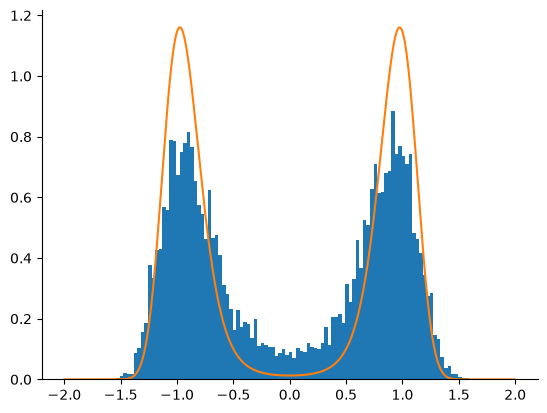
Sampling from the Rastrigin Potential
Experimental Setup
We consider a prior distribution and we want to sample from a Rastrigin type potential function where we choose . These potential functions are known to be particularly hard to sample.
We plot the resulting tempered density for 5 different values of : from which correponds to the original density to . The lower the value of the easier it is to sampler from the posterior log-density.
def V(x):
    d = x.shape[-1]
    res = -10 * d + jnp.sum(x**2 - 10 * jnp.cos(2 * jnp.pi * x), -1)
    return res


linspace = jnp.linspace(-5, 5, 5000)[..., None]
lambdas = jnp.linspace(0.0, 1.0, 5)
potential_vals = V(linspace)
log_res = lambdas[..., None] * potential_vals

density = jnp.exp(-log_res)
normalizing_factor = jnp.sum(density, axis=1, keepdims=True) * (
    linspace[1] - linspace[0]
)
density /= normalizing_factor
Source
fig, ax = plt.subplots(figsize=(12, 8))
ax.semilogy(linspace.squeeze(), density.T)
ax.legend(list(lambdas))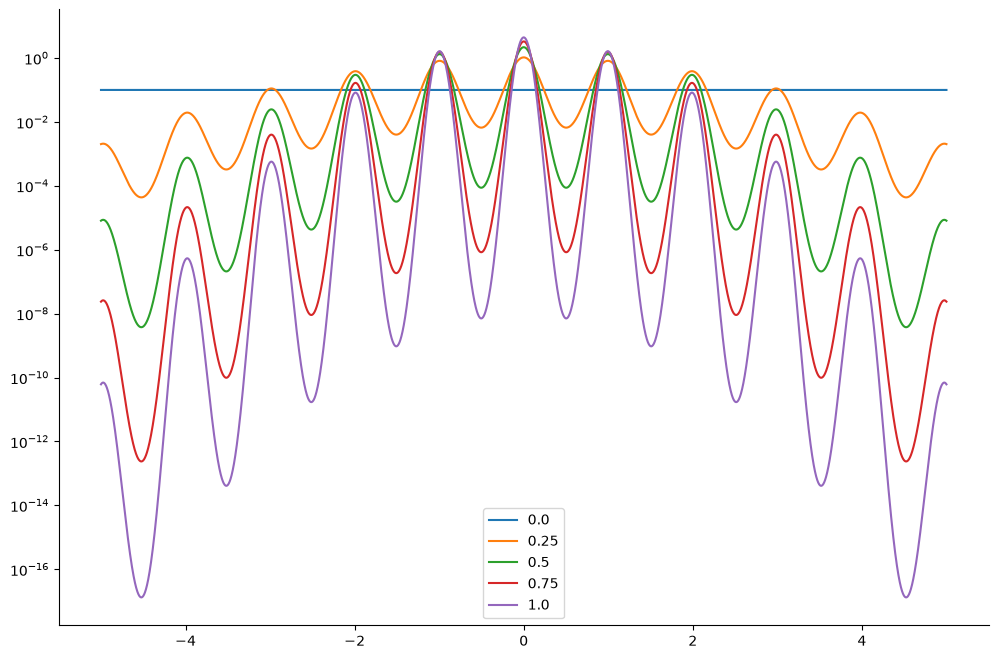
def inference_loop(rng_key, mcmc_kernel, initial_state, num_samples):
    def one_step(state, k):
        state, _ = mcmc_kernel(k, state)
        return state, state

    keys = jax.random.split(rng_key, num_samples)
    _, states = jax.lax.scan(one_step, initial_state, keys)

    return states


inv_mass_matrix = jnp.eye(1)
n_samples = 1_000
HMC Sampler
We first try to sample from the posterior density using an HMC kernel.
%%time

loglikelihood = lambda x: -V(x)

hmc_parameters = dict(
    step_size=1e-2, inverse_mass_matrix=inv_mass_matrix, num_integration_steps=50
)

hmc = blackjax.hmc(full_logdensity, **hmc_parameters)
hmc_state = hmc.init(jnp.ones((1,)))

rng_key, sample_key = jax.random.split(rng_key)
hmc_samples = inference_loop(sample_key, hmc.step, hmc_state, n_samples)
CPU times: user 1.31 s, sys: 11.1 ms, total: 1.33 s
Wall time: 889 ms
Source
samples = np.array(hmc_samples.position[:, 0])
_ = plt.hist(samples, bins=100, density=True)
_ = plt.plot(linspace.squeeze(), density[-1])
_ = plt.yscale("log")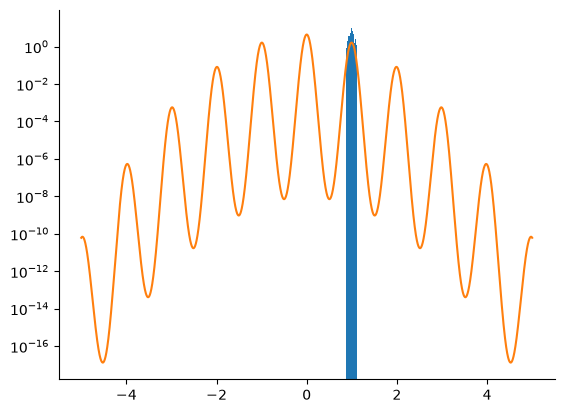
NUTS Sampler
We do the same using a NUTS kernel.
%%time

nuts_parameters = dict(step_size=1e-2, inverse_mass_matrix=inv_mass_matrix)

nuts = blackjax.nuts(full_logdensity, **nuts_parameters)
nuts_state = nuts.init(jnp.ones((1,)))

rng_key, sample_key = jax.random.split(rng_key)
nuts_samples = inference_loop(sample_key, nuts.step, nuts_state, n_samples)
CPU times: user 1.72 s, sys: 26.1 ms, total: 1.74 s
Wall time: 1.03 s
Source
samples = np.array(nuts_samples.position[:, 0])
_ = plt.hist(samples, bins=100, density=True)
_ = plt.plot(linspace.squeeze(), density[-1])
_ = plt.yscale("log")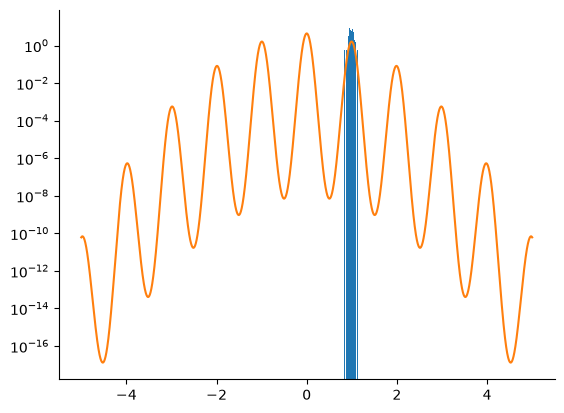
Tempered SMC with HMC Kernel
We now use the adaptive tempered SMC algorithm with an HMC kernel. We only take one HMC step before resampling. The algorithm is run until crosses the limit. We correct the bias introduced by the (arbitrary) prior.
%%time

loglikelihood = lambda x: -V(x)

hmc_parameters = dict(
    step_size=1e-2, inverse_mass_matrix=inv_mass_matrix, num_integration_steps=100
)

tempered = blackjax.adaptive_tempered_smc(
    prior_log_prob,
    loglikelihood,
    blackjax.hmc.build_kernel(),
    blackjax.hmc.init,
    extend_params(hmc_parameters),
    resampling.systematic,
    0.75,
    num_mcmc_steps=1,
)

rng_key, init_key, sample_key = jax.random.split(rng_key, 3)
initial_smc_state = jax.random.multivariate_normal(
    init_key, jnp.zeros([1]), jnp.eye(1), (n_samples,)
)
initial_smc_state = tempered.init(initial_smc_state)

n_iter, smc_samples = smc_inference_loop(sample_key, tempered.step, initial_smc_state)
print("Number of steps in the adaptive algorithm: ", n_iter.item())
Number of steps in the adaptive algorithm: 6
CPU times: user 3.77 s, sys: 39.9 ms, total: 3.81 s
Wall time: 1.92 s
Source
samples = np.array(smc_samples.particles[:, 0])
_ = plt.hist(samples, bins=100, density=True)
_ = plt.plot(linspace.squeeze(), density[-1])
_ = plt.yscale("log")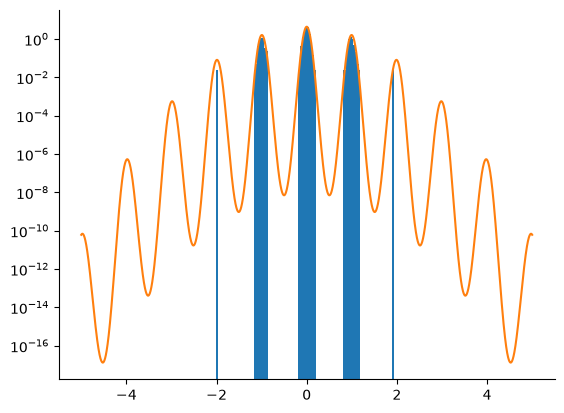
The tempered SMC algorithm with the HMC kernel clearly outperfoms the HMC and NUTS kernels alone.