The tempered SMC chapter showed that multimodal targets defeat energy-based samplers such as HMC and NUTS: escaping one potential well requires a rare, high-energy excursion, so a single chain stays trapped in whichever mode it started in. Particle methods can mitigate this, and nested sampling Skilling, 2006 is a distinctive and popular member of the family. Particle methods are also useful for estimating the marginal likelihood — the central quantity nested sampling was originally conceived to compute,
Rather than tempering the likelihood, nested sampling maintains a population of live particles drawn from the prior and repeatedly replaces the worst (lowest-likelihood) ones with a fresh prior draw constrained to lie above the discarded likelihood value. It shares much of its machinery with SMC, but takes a different path: instead of interpolating from prior to posterior by geometry or temperature, it walks a sequence of constrained priors , indexed by a likelihood threshold that ratchets upward from (the constraint is vacuous and is just the prior) toward the likelihood peak ( collapses onto the dominant mode). Because that threshold is set by the live particles themselves, the path is adaptive by construction. Nested sampling is also usually implemented with procedures that tune the inner MCMC kernel from the particle cloud of the previous iteration; in this respect it is natural to compare against inner kernel tuning, which exploits the same mechanism.
In this notebook we use blackjax.nss, the Nested Slice Sampling
implementation of Yallup et al., 2026, which pairs the generic nested-sampling
outer loop with a hit-and-run slice sampler as the inner kernel. That
pairing — a generic outer loop plus a pluggable inner kernel — is one instance of the
broader blackjax.ns primitives available for building samplers, and we return to them
in the synthesis.
The implementation follows the library’s standard init / step construction and acts
on a particle cloud much as SMC does; we flag the choices unique to nested sampling as
they arise.
This chapter demonstrates:
A Bimodal Target (Multimodality) — nested sampling and adaptive tempered SMC both populate the two modes from the prior and agree on the evidence; on this target the two are interchangeable.
A Phase Transition — a sharp spike holding 90% of the evidence makes the target a first-order phase transition: nested sampling compresses straight through it in prior volume, posing a stiff challenge for tempering approaches.
Notebook Cell
import matplotlib.pyplot as plt

plt.rcParams["axes.spines.right"] = False
plt.rcParams["axes.spines.top"] = False
import jax
import jax.numpy as jnp
import numpy as np
from jax.scipy.stats import multivariate_normal
from jax.scipy.special import logsumexp
import blackjax
from blackjax.ns.utils import finalise, log_weights, ess
from blackjax.ns.utils import sample as ns_sample
# adaptive tempered SMC with inner-kernel tuning, for the comparison throughout
from blackjax import adaptive_tempered_smc
from blackjax.smc import resampling, extend_params
from blackjax.smc.inner_kernel_tuning import as_top_level_api as inner_kernel_tuning
from blackjax.smc.tuning.from_particles import particles_covariance_matrix
from blackjax.mcmc import random_walk
rng_key = jax.random.key(42)Section 1: A Bimodal Target (Multimodality)
We inherit the example problem and SMC setup from tempered SMC: a prior
and a log-likelihood
. The algorithm consumes JAX functions defining a
logprior_fn and a loglikelihood_fn,
def loglikelihood_fn(x):
    return -5 * jnp.square(jnp.sum(x**2, axis=-1) - 1)


def logprior_fn(x):
    d = x.shape[-1]
    return multivariate_normal.logpdf(x, jnp.zeros((d,)), jnp.eye(d))
The likelihood peaks on the ring ; in one dimension that is the pair of modes at . Because the prior comfortably covers both, the initial live set — drawn straight from the prior — populates both modes from the outset. So far this mirrors the SMC setup exactly.
Running Nested Sampling
blackjax.nss follows the usual BlackJAX init / step pattern. The two algorithm
choices worth understanding are:
num_delete— how many of the lowest-likelihood live points are replaced per step. Together withnum_livethis fixes the volume compression per step, and hence the size of the outer move, playing a role similar totarget_essin adaptive SMC. Here each step keeps 90% of the live set (num_delete / num_live = 0.1), matching the SMC target ESS of 0.9.num_inner_steps— how many constrained slice moves generate each replacement point. The new point must decorrelate from the one it replaces, so a useful rule of thumb is to scalenum_inner_stepswith the dimension, of ordermax(5, 2*dim).
num_live = 1000
num_delete = 100

algo = blackjax.nss(
    logprior_fn=logprior_fn,
    loglikelihood_fn=loglikelihood_fn,
    num_inner_steps=5,
    num_delete=num_delete,
)Adaptive tempered SMC steps until its temperature reaches 1; nested sampling has no such landmark and
simply compresses until enough of the evidence has been collected. state.integrator
keeps the running totals that make that judgement — logZ accumulated from the dead points
and logZ_live, the optimistic contribution still held by the live set — and the standard
rule stops once the live set holds a negligible share:
Skilling, 2006, the dlogz default below.
def nested_sampling_loop(rng_key, algo, initial_particles, dlogz=-3.0):
    """Run nested sampling until the live points hold a negligible share of Z."""
    state = algo.init(initial_particles)
    step = jax.jit(algo.step)

    dead = []
    while True:
        rng_key, subkey = jax.random.split(rng_key)
        state, info = step(subkey, state)
        dead.append(info)

        if state.integrator.logZ_live - state.integrator.logZ < dlogz:
            break

return finalise(state, dead)The live points are initialised by sampling the prior directly, then we run the loop. The
finalise utility stitches the dead points together with the final live set into a single
NSInfo. Its particles carry, for every sample, the position, the loglikelihood, and
the loglikelihood_birth (the contour level at which the point was born) — everything
needed to assign importance weights after the fact.
%%time

rng_key, init_key, run_key = jax.random.split(rng_key, 3)
initial_particles = jax.random.normal(init_key, (num_live, 1))

ns_run = nested_sampling_loop(run_key, algo, initial_particles)
print("Number of dead points:", ns_run.particles.loglikelihood.shape[0])
Number of dead points: 5400
CPU times: user 6.49 s, sys: 304 ms, total: 6.79 s
Wall time: 3.38 s
With the run finalised, blackjax.ns.utils turns that bag of dead points into the
quantities we actually want. Each carries an importance weight
— its likelihood times the sliver of prior volume
that its shell swept out. The volumes are not known exactly but follow
a known stochastic law Skilling, 2006, so log_weights returns not one weight
per point but shape independent simulations of the whole volume sequence — which is what
lets every downstream quantity come with an error bar for free.
rng_key, w_key = jax.random.split(rng_key)

# Each dead point i carries log w_i = log L_i + log dX_i; the volumes are stochastic,
# so log_weights draws `shape` independent volume sequences (the columns).
logw = log_weights(w_key, ns_run, shape=200)          # (num_dead, 200)

# Evidence: sum the weights down the points, once per sequence -> mean and a free error bar.
logZ = logsumexp(logw, axis=0)
print(f"log Z = {logZ.mean():.3f} +/- {logZ.std():.3f}")

# The weights are very uneven, so the raw dead-point count overstates the information held.
# ess reports the equivalent number of equally-weighted posterior draws.
print(f"effective sample size = {ess(w_key, ns_run):.0f}"
      f"  (from {ns_run.particles.loglikelihood.shape[0]} dead points)")
log Z = -1.565 +/- 0.035
effective sample size = 3184 (from 5400 dead points)
Particle Methods mitigate energy barriers
We built the importance weights above; sample (blackjax.ns.utils.sample) closes the loop,
resampling the dead points by those weights — log_weights followed by a draw with
replacement — into the equally-weighted posterior draws we plot.
rng_key, sample_key = jax.random.split(rng_key)
posterior = ns_sample(sample_key, ns_run, 4000).position[:, 0]
A single nested-sampling run recovers both modes with the correct relative weight — exactly where HMC and NUTS got stuck.
We use adaptive tempered SMC for comparison: a random-walk Metropolis inner kernel whose proposal covariance is tuned from the particle population at every temperature (the inner-kernel tuning of the preamble, with the optimal scaling), summing the per-temperature normalising constants for .
def adaptive_smc(rng_key, logprior_fn, loglikelihood_fn, initial_particles,
                 num_mcmc_steps, target_ess=0.9):
    """Adaptive tempered SMC with a random-walk kernel tuned from the particles."""
    d = initial_particles.shape[-1]
    rmh_kernel = random_walk.build_rmh()

    def rwmh_step(key, state, logdensity, cov):
        move = lambda k, x: jax.random.multivariate_normal(k, x, cov)
        return rmh_kernel(key, state, logdensity, move)

    def tune_from_particles(key, state, info):  # ITK: cloud at step i sets step i+1
        cov = jnp.atleast_2d(particles_covariance_matrix(state.particles))
        return extend_params({"cov": (2.38**2 / d) * cov})

    smc = inner_kernel_tuning(
        logprior_fn=logprior_fn,
        loglikelihood_fn=loglikelihood_fn,
        mcmc_step_fn=rwmh_step,
        mcmc_init_fn=random_walk.init,
        resampling_fn=resampling.systematic,
        smc_algorithm=adaptive_tempered_smc,
        mcmc_parameter_update_fn=tune_from_particles,
        initial_parameter_value=extend_params({"cov": jnp.eye(d)}),
        target_ess=target_ess,
        num_mcmc_steps=num_mcmc_steps,
    )

    loglike_v = jax.vmap(loglikelihood_fn)
    state = smc.init(initial_particles)
    step = jax.jit(smc.step)
    logZ = 0.0
    mean_logL = []                    # E[logL] of the ensemble at each temperature step
    while state.sampler_state.tempering_param < 1:  # run until temperature reaches 1
        rng_key, subkey = jax.random.split(rng_key)
        state, info = step(subkey, state)
        logZ += info.log_likelihood_increment
        mean_logL.append(loglike_v(state.sampler_state.particles).mean())
    return logZ, state.sampler_state.particles, jnp.array(mean_logL)
%%time
rng_key, smc_init_key, smc_key = jax.random.split(rng_key, 3)
smc_particles = jax.random.normal(smc_init_key, (5000, 1))
logZ_smc, smc_post, _ = adaptive_smc(
smc_key, logprior_fn, loglikelihood_fn, smc_particles, num_mcmc_steps=10
)
print(f"tempered SMC log Z = {logZ_smc:.3f}")tempered SMC log Z = -1.556
CPU times: user 5.53 s, sys: 103 ms, total: 5.63 s
Wall time: 1.94 s
Both particle methods recover both modes, and agree on the evidence (). On this target they are interchangeable; the next section finds one where they are not.
Source
linspace = jnp.linspace(-2, 2, 2000)[:, None]
density = jnp.exp(loglikelihood_fn(linspace) + logprior_fn(linspace))
density /= jnp.sum(density) * (linspace[1, 0] - linspace[0, 0])

fig, ax = plt.subplots()
ax.hist(np.array(posterior), bins=80, density=True, histtype="step", lw=1.5, label="nested sampling")
ax.hist(np.array(smc_post[:, 0]), bins=80, density=True, histtype="step", lw=1.5, label="tempered SMC")
ax.plot(np.array(linspace[:, 0]), np.array(density), "k", lw=1, label="true density")
ax.legend()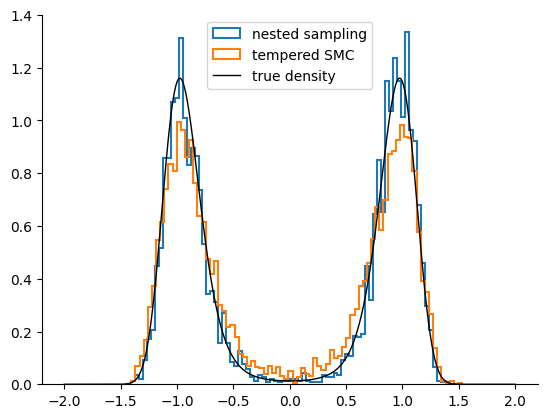
Section 2: A Phase Transition
The bimodal target was easy enough that tempered SMC matched nested sampling. The classical example that separates them has a phase transition — the regime nested sampling is built for. We demonstrate it with a simple mixture of Gaussians with exaggerated features, though physical systems routinely exhibit such transitions (a liquid boiling, a ferromagnet magnetising). Along the path from prior to posterior the probability mass can jump discontinuously between regions, leaving a band of intermediate distributions that hold almost no mass — the sampling analogue of latent heat. We will show that nested sampling, marching by prior volume, contracts straight through it.
Our target is a likelihood under a flat prior on : a broad Gaussian background () plus a narrow spike () at the origin. Evidence is height volume, and the spike’s volume is only of the background’s; to make the transition sharp we scale the spike tall enough () that it still carries ~90% of . Resolving that spike is the whole challenge.
D = 10
box_low, box_high = -5.0, 5.0
log_box_volume = D * jnp.log(box_high - box_low)

means = jnp.zeros((2, D))
sigmas = jnp.array([1.0, 0.1])       # broad background, narrow spike
heights = jnp.array([1.0, 9e10])     # spike ~9e10 taller, so it holds ~90% of Z


def loglikelihood_mix(x):
    sq_dist = jnp.sum((x - means) ** 2, axis=-1)
    return logsumexp(jnp.log(heights) - sq_dist / (2 * sigmas**2))


def logprior_mix(x):
    inside = jnp.all((x >= box_low) & (x <= box_high))
    return jnp.where(inside, -log_box_volume, -jnp.inf)
The same height-times-volume accounting gives the analytic evidence to check against — a
logsumexp over the two components, minus the log box volume — and confirms the split:
# each Gaussian bump integrates to h * (2 pi sigma^2)^(D/2); the flat prior divides by V
component_logZ = jnp.log(heights) + (D / 2) * jnp.log(2 * jnp.pi * sigmas**2)
logZ_analytic = logsumexp(component_logZ) - log_box_volume
evidence_share = jnp.exp(component_logZ - logsumexp(component_logZ))
print(f"analytic log Z = {logZ_analytic:.3f}   "
      f"evidence share [broad, spike] = {np.round(np.array(evidence_share), 3)}")
analytic log Z = -11.534 evidence share [broad, spike] = [0.1 0.9]
We reuse Section 1’s nested_sampling_loop and adaptive_smc unchanged, adjusting only a few
settings for this harder, ten-dimensional target. Nested sampling keeps 1000 live points,
deletes the same 10% each step (num_delete = 100), and runs num_inner_steps = 2D slice moves —
and, crucially, compresses much deeper: dlogz = -10 rather than -3 (the phase transition
below is why — stop too early and it quits before reaching the spike). Tempered SMC is
given a comparable compute budget: a fine target_ess = 0.99 schedule (~55 temperatures) with
num_mcmc_steps = 10D random-walk moves per temperature. First nested sampling:
%%time

n_live, n_delete = 1000, 100     # delete 10% of the live set per step
algo_mix = blackjax.nss(
    logprior_fn=logprior_mix,
    loglikelihood_fn=loglikelihood_mix,
    num_inner_steps=2 * D,
    num_delete=n_delete,
)

rng_key, init_key, run_key, z_key = jax.random.split(rng_key, 4)
live = jax.random.uniform(init_key, (n_live, D), minval=box_low, maxval=box_high)
nss_mix = nested_sampling_loop(run_key, algo_mix, live, dlogz=-10.0)

logZ_nss = logsumexp(log_weights(z_key, nss_mix, shape=300), axis=0)
print(f"NSS log Z = {logZ_nss.mean():.3f} +/- {logZ_nss.std():.3f}")
NSS log Z = -11.511 +/- 0.176
CPU times: user 14.1 s, sys: 557 ms, total: 14.7 s
Wall time: 8.03 s
and then tempered SMC:
%%time

rng_key, init_key, run_key = jax.random.split(rng_key, 3)
particles = jax.random.uniform(init_key, (5000, D), minval=box_low, maxval=box_high)
logZ_smc, smc_post, smc_meanL = adaptive_smc(
    run_key, logprior_mix, loglikelihood_mix, particles, num_mcmc_steps=10 * D,
    target_ess=0.99,
)
print(f"tempered SMC log Z = {logZ_smc:.3f}")
tempered SMC log Z = -13.819
CPU times: user 26.4 s, sys: 1.43 s, total: 27.8 s
Wall time: 10.5 s
Nested sampling recovers , right on the analytic -11.5; tempered SMC, despite its finer schedule, returns -13.8 — low by more than two nats, having missed the spike that holds 90% of the evidence. Equally-weighted posterior draws from each run show the miss directly:
Source
rng_key, sample_key = jax.random.split(rng_key)
nss_post = ns_sample(sample_key, nss_mix, 4000).position[:, 0]

# true marginal along one axis: an evidence-weighted mix of the two Gaussians
xs = np.linspace(-3, 3, 2000)
share, sig = np.array(evidence_share), np.array(sigmas)
true_marg = sum(
    share[i] * np.exp(-(xs**2) / (2 * sig[i] ** 2)) / (sig[i] * np.sqrt(2 * np.pi))
    for i in range(2)
)

fig, ax = plt.subplots()
ax.hist(np.array(nss_post), bins=120, range=(-3, 3), density=True,
        histtype="step", lw=1.5, label="nested sampling")
ax.hist(np.array(smc_post[:, 0]), bins=120, range=(-3, 3), density=True,
        histtype="step", lw=1.5, label="tempered SMC")
ax.plot(xs, true_marg, "k", lw=1, label="true marginal")
ax.set_yscale("log")
ax.set_ylim(1e-3, 6)
ax.set_xlabel(r"$x_0$")
ax.set_ylabel("density")
ax.legend()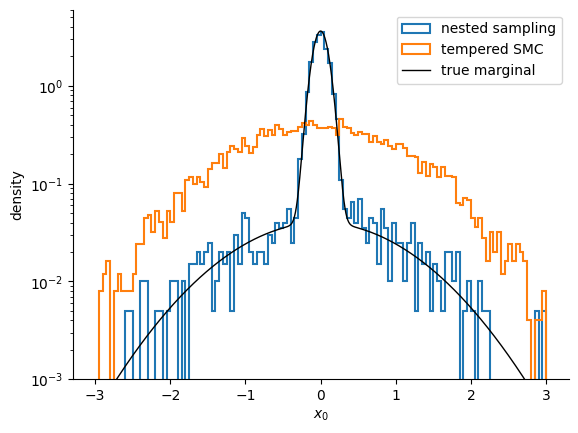
Nested sampling piles onto the narrow spike at the origin, tracking the true marginal; tempered SMC stays spread across the broad background — precisely the mass it undercounts in . The compression curves show why.
Exploring the robustness of Nested Sampling
We can probe how differently the two algorithms see the problem using the full particle history. We plot the mean log-likelihood of the population as each method iterates — nested sampling (left) as it compresses, tempered SMC (right) as it heats — on a shared -axis, with a dotted reference at the spike’s typical set, the log-likelihood a sampler must reach to have resolved the spike.
Source
logL = np.sort(np.array(nss_mix.particles.loglikelihood))

# NS live-set mean log-likelihood at each iteration: a window of n_live sorted points,
# stepped by n_delete. Reconstructed from the finalised points — no extra bookkeeping.
starts = np.arange((logL.size - n_live) // n_delete) * n_delete
ns_meanL = np.array([logL[s : s + n_live].mean() for s in starts])
ns_iter = starts / n_live       # equivalent NS iterations (whole-population moves)
smc_meanL = np.array(smc_meanL)

# the spike Gaussian's typical set sits D/2 nats below its peak log-height
spike_ts = float(np.log(np.array(heights[1]))) - D / 2

fig, (ax1, ax2) = plt.subplots(1, 2, figsize=(11, 4), sharey=True)

ax1.plot(ns_iter, ns_meanL, lw=1.4, color="C0", label=r"mean $\log\mathcal{L}$")
ax1.axhline(spike_ts, ls=":", color="k", lw=1.2, label="spike typical set")
ax1.set_ylim(-45, 27)
ax1.set_xlabel("equivalent NS iteration (logL step)")
ax1.set_ylabel(r"$\log \mathcal{L}$")
ax1.set_title("Nested Sampling Compression")
ax1.legend(fontsize=8, loc="lower right")

ax2.plot(np.arange(1, smc_meanL.size + 1), smc_meanL, "o-", ms=3, lw=1.4, color="C1",
         label=r"mean $\log\mathcal{L}$")
ax2.axhline(spike_ts, ls=":", color="k", lw=1.2, label="spike typical set")
ax2.set_xlabel(r"SMC iteration ($\beta$ step)")
ax2.set_title("Tempered SMC Compression")
ax2.legend(fontsize=8, loc="lower right")
fig.tight_layout()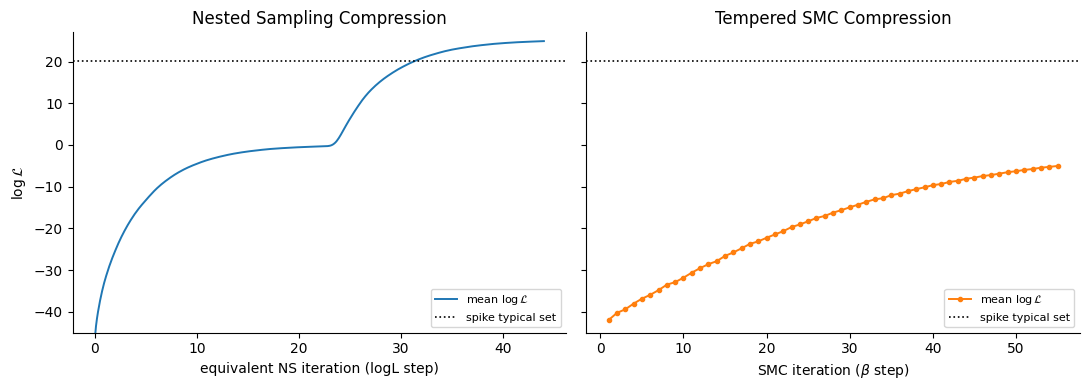
Nested sampling takes uniform steps in the enclosed prior volume, so around the transition — the plateau where the two phases meet — its steps in log-likelihood automatically shorten. Because the volume compression continues uniformly regardless, the effective log-likelihood step readapts to the narrow Gaussian spike and keeps progressing with well-chosen step sizes. Tempered SMC never does: its ensemble climbs off the prior, then plateaus in the background far below the spike, because raising exerts no pull toward a peak that holds almost no probability until — by which point its proposal is far too coarse to find it. Even an extremely fine, fixed schedule stays pathological for the tempering approach.
This is why we set the termination target so deep: across the gap the live points genuinely hold
almost nothing, so the usual dlogz = -3 would quit early — hence dlogz = -10. For standard
probabilistic problems -3 is a sensible general-purpose default, but this athermal
compression is a defining feature of nested sampling, and on many physical systems the deeper
compression is worth paying for.
SMC, by contrast, is left at -13.8 even with its fine annealing schedule (target_ess = 0.99,
~55 temperatures). First-order phase transitions are the textbook failure of thermal methods, and
precisely the regime nested sampling is built for; this target just makes it explicit.
Synthesis
We have demonstrated the nested sampling algorithm and positioned it alongside the SMC approaches already in BlackJAX. On the two problems studied we saw:
Multimodality (both agree). When the obstacle is an energy barrier between well-resolved modes, both methods draw particles into every well straight from the prior, so tempering and volume compression weight the modes alike and return the same . On the bimodal target the two are interchangeable.
A phase transition (nested sampling stays robust). When 90% of the evidence hides in a sharp, low-volume spike, the target is a first-order phase transition: nudge past the transition and SMC’s random walk must leap straight from the broad background into the spike, so it never resolves it and its comes out nats too low. Nested sampling parametrises the path by prior volume instead and keeps compressing straight through the trough — the robustness a volume parametrisation buys at a first-order transition.
Built from primitives. Both samplers are assembled from the same two BlackJAX pieces —
a generic outer loop that replaces the worst live points under a rising likelihood
constraint, and a pluggable inner kernel that draws the replacements. blackjax.nss fills
that slot with a hit-and-run slice sampler; an axis-aligned slice-within-Gibbs move gives
blackjax.nsswig instead, and any sampler that can draw from the constrained prior would
serve. That modularity is the skeleton shared with SMC, and what lets the preamble’s
inner-kernel tuning drop into both.
In practice. Despite these attractive properties, some of nested sampling’s strengths are limited by the difficulty of constrained sampling. The most natural inner kernel is the slice family — a powerful engine, but one that cannot on its own reach the dimensionality that gradient-based HMC does. BlackJAX’s structure-aware design lets one build a Metropolis-within-Gibbs kernel to scale further Yallup, 2026, or bring in Laplace marginalisation of latent variables.
The blackjax.ns package also exposes a generic blackjax.ns.from_mcmc utility for building
custom kernels, along with base and adaptive abstractions for further research into practical constrained samplers.
- Skilling, J. (2006). Nested sampling for general Bayesian computation. Bayesian Analysis, 1(4), 833–859. 10.1214/06-BA127
- Yallup, D., Kroupa, N., & Handley, W. (2026). Nested Slice Sampling: Vectorized Nested Sampling for GPU-Accelerated Inference. Transactions on Machine Learning Research. https://openreview.net/forum?id=5mF2eRl3gt
- Yallup, D. (2026). Nested Sampling with Slice-within-Gibbs: Efficient Evidence Calculation for Hierarchical Bayesian Models. https://arxiv.org/abs/2602.17414